Yes, I missed a few weeks. Oh well. The memories are still being made. :)
This was a busy week. We went camping (again!), this time with my parents. Jeff had to work so he missed out on the fun.
As for the rest of the week, we rushed a bit to get our school done so we could relax and play over the weekend. Hailey is still enjoying her reading lessons, although they don't hold the novelty that they first did. They still help her with those longer stories and unknown words, so we will keep at it. She is working on reading stories that are several pages long, and is reading words like "indignantly", and "comfortable". I am working to help her start reading those school books which are way over her reading level, but right-on as far as comprehension. They are tough for her, so we work through them together.
Abby is working on learning basic CVC words, in word families. She is studying each word family, and then building and saying them with word tiles. We are also working some with sight words. At this point I am not pushing her to KNOW all the sight words, I just want her to have an association with them. Later, when she starts first grade, she will be learning all the words. This is just an introduction!
Caiden's reading is going exceptionally well. He is working though the last part of his reading program, and although he doesn't enjoy the actual program, he does like reading, especially science books (of course!) on his own. He likes sounding out the names of different animals and plants, although most of the time he has trouble getting them right since they aren't phonetic.
This week we did our usual, biographies and history books are a big part of our curriculum. Hailey likes all of her books except Along Came Galileo, and she said that is because I make her read it herself. Silly girl. :) Caiden likes his books too, especially Pilgrim's Progress! I was surprised because that is one of the hardest books for this year. His other favorite books is also the other hardest book, Little Duke. This is a biography of a young duke of Normandy, written in old-style language with many hard to understand words. He does great with it! I can just see their minds growing.
That is all for now... next week I will explain all about Hailey's history for this year. No pictures for now, maybe I will add them later. They take so long to upload because I insist on editing them. ;)

Tuesday, August 6, 2013


Sunday, July 7, 2013
Weekly wrap up~ Week One
Week one is done! Well, week one-half technically. We are starting out slow so we did about half of our math and language arts lessons each day, and half of the weeks readings. Next week we will do everything. :)
The kids were so excited to begin their new grades, although it really doesn't mean anything to them except new books. We only schooled for 3 days, because the holiday was on Thursday. On Friday, we headed to the mountains for a short camping trip. Our first week went great! The kids enjoyed all of their books, so far, and the new Charlotte Mason-style reading and spelling lessons were and overwhelming success. They said they like ALL of school now, because we got rid of those irritating phonics lessons with all that writing.
Instead of workbooks, we are doing spelling on the white board or a notebook. I simply pick a word from the reading lesson and together we think of all the words in that family. I write them on the board, and she attempts to place them into her visual memory by taking a 'picture' of each word. Then I erase the words and she writes them from memory. The whole process only takes about 5 minutes. For Caiden's phonics I did away with the worksheets which were used for spelling practice, and instead we have spelling lessons every other day.
We do several lessons for language arts each day. These lessons are all short, and we don't do them all at once. Instead, working on the principle that brains get tired after too long on one subject, we do one and then go to something completely different before coming back to another lesson. Hailey and Caiden have a reading lesson two days a week, and spelling on the off days. We do copywork everyday.
As we left for the 4th of July parade, we saw three baby deer and two does having breakfast. I was so excited, I have been watching for them for weeks!
 |
Fireworks~Three kiddos and an aunt. |
Instead of workbooks, we are doing spelling on the white board or a notebook. I simply pick a word from the reading lesson and together we think of all the words in that family. I write them on the board, and she attempts to place them into her visual memory by taking a 'picture' of each word. Then I erase the words and she writes them from memory. The whole process only takes about 5 minutes. For Caiden's phonics I did away with the worksheets which were used for spelling practice, and instead we have spelling lessons every other day.
We do several lessons for language arts each day. These lessons are all short, and we don't do them all at once. Instead, working on the principle that brains get tired after too long on one subject, we do one and then go to something completely different before coming back to another lesson. Hailey and Caiden have a reading lesson two days a week, and spelling on the off days. We do copywork everyday.
As we left for the 4th of July parade, we saw three baby deer and two does having breakfast. I was so excited, I have been watching for them for weeks!
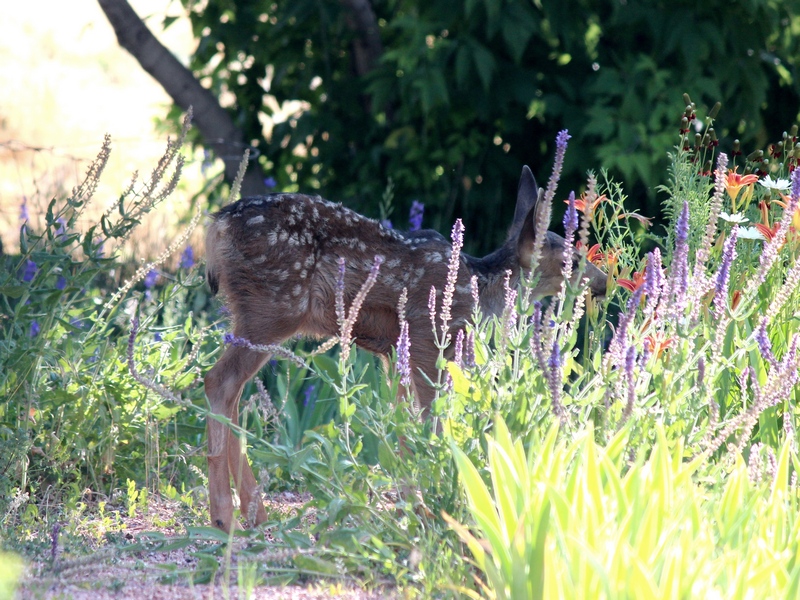 |
Tasting the flowers. |
 |
These twins were a little older, and trying a few bites. |
 |
Mama and twins. |
 | ||
This baby was very little, so mama kept him pretty well hidden. He was still toddling when he tried to run.
Later we headed to the lake to watch fireworks. The next morning we were on our way to the mountains... a whole 15 miles away, we stopped to camp in the National Forest. We finally found an un-occupied campsite, without anyone else (Or their dog) around. The kids learned how to set up the tent first. Later, they got to practice starting a fire and had some gun safety lessons. We took several hikes, but had to keep them short because we forgot the baby carrier. :)
Nature study was everywhere, of course, but we worked carefully to identify wildflowers. We found many different kinds, more variety then I have ever seen. Colorado columbines, pink and white paintbrushes, (which were new to me, ) bitter cress, orange sneeze weed was everywhere, pink elephants (Which I have wanted to see since I was a little girl, first fascinated with field guides), and toxic monkshood. Soon the kids were calling out whenever they saw those dark purple flowers, "There's the poisonous ones! Stay away!" I was so proud. :) We brought several specimens home to press and mount, and they will know them forever.
I love what I do. :) |

 |
Reading Charlotte Mason's advice on "The Outdoor Life" for children, while enjoying the mountains... what could be more appropriate? |
 |
Nature Study~ Wildflowers |
 |
Abby investigating a smallColorado columbine. |
Wednesday, July 3, 2013
Charlotte Mason in 5 minutes

I have had several requests for a summary of Charlotte Mason's philosophy and ideas. Because I have a tendency to be very wordy and over-complicate things, I decided to write something that could be read in 5 minutes. Most of these topics will apply to younger children, not those in High School. I haven't had time to study that yet. :)

Charlotte Mason was an education reformer, teacher, and directer of a chain of schools in the late eighteen- hundreds. Many of her ideas were revolutionary then, and are still unique today. The first thing to emphasize is that Charlotte herself was opposed to her work being used as any kind of 'system'. She was adamant that a method, a philosophy, is flexible and useful, while a stringent system is constrictive. Charlotte also insisted that parents could teach their children as well or better then a school, and her first book is considered the original how-to book on homeschooling.
Charlotte believed children, especially young children, should spend the majority of their time outside. She recommended at least 6 hours outside each day! These hours were not spent just in idle playtime, but were used to teach and develop many things. The habit of attention is learning carefully studying flowers. The ability to envision something in their heads, so important for learning to read, is learned by studying a scene and imprinting it in their minds. The ability to tell something back, describing it for others, which is the first step in learning to write well, can be practiced by describing that scene. Visual development is enhanced by having long vistas to focus on. And, of course, there is no where children are happier then outside!

Living books are a very important part of any Charlotte Mason method. Living books are simply REAL books, as opposed to textbooks. But living books are also more. The foundational idea behind living books is the importation of ideas. Children's minds are fed upon ideas, and books which only give facts, dry knowledge, and miscellaneous tidbits of information do not feed children's minds. Look for books that are the best of the best. They inspire, delight, and motivate. Not all good, fun books are living. Books that have depth and a heart and soul are important. Ambleside Online, Sonlight, Heart of Dakota, Winter Promise, Five in a Row and other literature-based curriculum are a good place to start in your search for living books Keep in mind that although these are good starting points, not nearly all of the books used by some of these are 'living' by Charlotte's standards. Also, the methods used by some of them are not in keeping with Charlotte's ideas. Our children deserve only the best ideas to nourish their growing minds.
HISTORY: History is described by Charlotte as a pageant of ideas. One of my favorite Charlotte quotes:
It is a great thing to possess a pageant of history in the background of one's thoughts. We may not be able to recall this or that circumstance, but, 'the imagination is warmed'; we know that there is a great deal to be said on both sides of every question and are saved from crudities in opinion and rashness in action. The present becomes enriched for us with the wealth of all that has gone before.

She wants children to form their own relationships with the people, events, and locations of history. This is where her method differs from Unit Studies, which try to do the connecting for the child by planning all subjects around a central theme. This delightful study of history comes, of course, from living books. The influence of one great mind, the author, upon one eager mind, the child, is the transfer of ideas at its best. children learn history from learning its stories. The stories are what we all remember and is what makes history alive. Dates, events, and people are meaningless to children if not surrounded by the comforting and inspiring blanket of a story.
This does not mean children need watered down, juvenile adaptations for history. This means they need well-written, quality, non-fiction history books, which are by their very definition, already living. This means wonderful spines, the book which brings it all together into one 'pageant of history', along with life-stories, biographies that are well-written and inspiring, should be the children's history curriculum. Well-written, accurate historical novels can be added to feed the mind in events, lifestyles, and give them a sense of 'being there', always being careful to let young children know when they are reading a realistic novel, not a biography.
GEOGRAPHY: Geography is approached in a slightly different way. The best way for children to learn basic concepts in geography is to talk with them as they are spending their outdoor time with you. Learning mountains, hill, dales, and valleys, along with all the other landforms will inspire their minds to imagine greater and grander things in other places. Children can learn direction, the water cycle, and many other things outside through short, gentle conversations. These are not lectures, mind you! Just the gentle conversation which a mother should already have with her child, inspiring great ideas through little things.
SCIENCE: Science should be given to the children as a living thing. Nature study is the most important part of a young child's science development, and paves the way for harder things to come. Learning to really study, see, and remember the minute and great things they encounter outside, will develop the skills they need for harder science subjects later. Living books can also be added, helping children develop ideas about things they cannot observe on their own. Always taking care, of course not to over-feed the imagination with words when nature, full of the real things, lays right outside the door!
For the evil is, that children get their knowledge of natural history, like all their knowledge, at second hand. They are so sated with wonders that nothing surprises them.

Charlotte also believed that is was important to give children beauty. Beauty is the inspiration, the hope, the imagination, of bettering the future. The child's natural appreciation for beauty can be easily squelched if it is not fed beauty on a regular basis. This is done through great works of are, great music, great literature, great poetry, and, of course, the great works of art of God himself, nature. My children regularly look at pictures by famous artists and listen to the works of the great composers. This is easier and less complicated then it sounds, and we do it in a few minutes every morning.
Developmental skills are also encouraged by this practice. Careful observation is formed by studying a picture for all its details and nuances. A listening ear is developed by allowing the music of great composers to take them away in imagination. Critical thinking comes as a child tries to dig the deeper meaning out of poetry- not for a literature class, but for his own enjoyment.
LANGUAGE ARTS: Language and writing skills can be taught in a developmentally appropriate and enjoyable way. The modern push to get children writing at younger and younger ages is meaningless until their mental facilities are capable. Writing down your thoughts is an incredible complex process, which should not be pushed until several separate abilities have been mastered.
 The physical act of writing is one of these skills, and Charlotte taught this through copywork. First, the children learn their letters and how to form them. After that skill is mastered, copywork, and then studied dictation, is the next step. Copying the great writings of others, through poetry, prose, and Bible verses, teaches much more then just handwriting. It also teaches how the English language works, with its subtle nuances of grammar, spelling, and punctuation.
The next step in learning to write well, is learning to order your thoughts and tell a story. The ability to write depends on the ability to think, create ineligible sentences and paragraphs, and use delightful language. Charlotte Mason taught this through narration. Narration is simply the practice of telling back what you have learned. For very young children, only a sentence or two is asked. As they mature, more details are required and expected. The skills learned through this practice are two-fold and vital.
First, the child learns to learn. He develops his mind and abilities to focus and remember. Charlotte went so far as to say "A reading not narrated is a reading wasted". The process begins when the child is young, talking about his observations in the natural world. It culminates in highschool with the ability to give long written narrations, although the spoken narrations are always used as well.
The second use for narration is the writing skills developed. The skills developed separately, through copywork, dictation, and narration, are then combined in the upper grades as the children begin actually writing, with pen and paper (or computer, these days!) what they have read. Creative writing is also encouraged.
Because you only have five minutes to read this, I will leave off here. The subjects of math and reading instruction are best left for more detailed articles, and more learned authors. I will end by saying, in my estimation, the methods of Charlotte Mason are as close as you can get to a perfect, mind-building, child-inspiring, idea-giving, life-breathing education as you can get. Yes, I am prejudiced. No, Charlotte Mason and Ambleside Online are not for everyone. But for those of you who try it, even adding parts to your other curriculum, I think you will find it transforming the way you teach and learn.
 |
For more information, visit the following links:
About Charlotte Mason and her methods
Getting Started
For Beginners
Charlotte Mason's Educational Philosophy
Charlotte Mason's writings in modern English paraphrase
A summary of Charlotte's 20 educational principles
Living Books
What ISN'T Living Books?
A Subject-by-Subject Charlotte Mason Series ~Highly recommended!
Narration
Imparting Living Ideas
The Art of Reading Slowly
Free Resources
Monday, July 1, 2013
How to Make a Timeline Binder

My children have timeline binders which they add to year after year as they go through history. Although we use Ambleside Online, a timeline binder could be used with any curriculum. It would be especially nice to tie together unit studies. Because the child adds things throughout his schooling years, it becomes a sort of treasured keepsake, and a story of what he has learned and how he has developed.
Here are some pictures of Hailey's timeline binder. She has been adding to hers for about a year. It is already special to her!


Here is what you will need for your timeline.
Binder
Cardstock
Paper
Notebooking pages
Timeline pages
*Shameless plug*I love NotebookingPages.com. I love them. I have used them many, many times since I bought my first package deal, and it has paid for itself many times over. That was back before Notebooking Pages became a membership site. Now the deal is even better! Not only do you get hundreds of pages, you get access to them, along with any new ones, forever!
*End of shameless plus*
I used Notebooking Pages for every part of my binders. But you could use something else. The important part is that you have timeline pages, notebooking pages on your topics, and some dividers. Here is how I put my timeline together. The first one was a bit tougher, because I had to figure out all of the time periods, how many pages I needed, how much to cover on each page, and all that. Caiden's was much easier. I just copied everything from Hailey's.
 |
Timeline and book lists from Notebookingpages.com |
First, I used cardstock to divide the timeline into four periods. This works well for us, because although Ambleside uses a 6 year rotation, the time periods are pretty general to most historical eras. These are also the divisions that most Classical programs use, and the divisions used by Notebooking Pages. The first divider is for ancient times. Then comes Middle Ages, Renaissance and Reformation, and the final division is for the Modern age. Because these time periods are subjective, I used Ambleside Online's dates as a rough guide. Here are my dates:

Ancient times: ..... to 800 AD
Middle Ages~ 800 to 1400
Renaissance and Reformation~ 1400 to 1700
Modern Times~ 1700 to 2100
My dividers are labeled with the time period and the dates. I print them on cardstock for durability. Behind the dividers, I printed book lists. We will add the books we read each year. This will make an interesting record later.
Now for the actual timeline. I printed pages from Notebooking Pages. I picked the format I liked the best, but feel free to do your own. You should also be able to find other options online. I printed one two-page spread for each century. Here are the pages needed for each section:

10 pages, 1000 years
Middle Ages:
12 pages, 600 years
12 pages, 600 years
Renaissance and Reformation:
6 pages, 300 years
6 pages, 300 years
Modern Times:
16 pages, 400 years.
(Here I switched to 50 years per each 2-page spread for the years between 1700 and 1900. I planned 25 pages for each spread for the last century. )
16 pages, 400 years.
(Here I switched to 50 years per each 2-page spread for the years between 1700 and 1900. I planned 25 pages for each spread for the last century. )
A note about ancient times: Because opinions differ and facts are hard to come by, I wasn't quite sure how to do this section. I just made 1000 years worth for now. On the one hand, I love the idea of having all of the history laid out in the same format, one century per spread, so the vastness of history is obvious. On the other hand, that would mean 40 pages, many of which would be blank. And that is just to go back to a young-earth creation. I will probably end up making a spread for every 200 or even 500 years, but this is something that I will worry about later.
The best part about the timeline binder is the part that makes them truly theirs. The part that makes them special. At the beginning of the school year, or before each term, I pull up Notebooking Pages and refill my ink cartridge. (Remember, many of these notebook pages could be found online in other places. Although I think that Notebooking Pages are the best and the easiest. ;) ) I grab the kid's history spines (their main history books) and start printing.

For first grade, I looked for the most important people and events. I went through the books, and printed a notebook page for each event or person that seemed most prominent and influential. I also printed coloring pages (which Notebooking Pages has for each time period) as well as some pages without a topic.
For second grade, I tried to come up with at least one page for each week. Some pages have more, some have less, but that was my goal. I stuck to pages that have a picture of the person or event, along with a place to draw a picture of their own. I kept the writing lines to a minimum for both grades, as they are already doing other copywork. For first grade, I often had her narrate to me while I wrote the words.
These notebook pages go into the binder, right behind the century-spread they happened in. We also mark the person or event in the timeline itself. Every year, as we learn more, we add to the same binder. So by the end of highschool, we may a little crayon drawing about the children's crusade on one page, while the next contains a detailed written narration about the captivity of Richard the Lionhearted. What a treasure and wealth of information these books will become, if worked on diligently!
However, we must be careful with the notebooking. The idea is not to have them doing extra work, the idea is to give them another way in which to connect with the stories and people. It also gives them a framework of events and people which they can build on later. Charlotte Mason was very clear about her opinion of busy work; that is, school work that is designed just to keep the child busy and does not give them living ideas. We must be careful that our timelines don't turn into busywork. It is not a chore for the child to do, it is not a test, it is not to see how much they know. It is THEIR book. They are designing it, they add what they like, what inspires them, what they want to remember. It is theirs.
 Sometimes I will say, "Here's a page about so and so. What would you like to do on it?" This is because when presented with an enormous supply of blank pages and an enormous supply of living ideas, a young child may be overwhelmed and not want to add any of them. I prefer to give them a starting place, and let them go from there. But I never force them to write more on their pages then they want. And if they get that look of "oh, no. I am too tired to write more!" I offer to write it for them. This is not copywork (although if you pick historical selections, their copywork could go into their timeline). This is a place for the child to make connections and memories.
I don't know how "Charlotte Mason" the idea of notebook pages is. I do know that young children didn't do written narrations in Charlotte's schools, which is why I am perfectly willing to do the writing for them. I also know that Charlotte's children had timelines, which they added events and people to, even in younger grades. Hailey really enjoys looking back through her binder, and remembers well every story that she included. It has really helped her retention.
Do you think notebook pages go against Charlotte's philosophies?
Saturday, May 25, 2013
Colorado National Monument

A few weeks ago, during National Parks Week, we loaded up the kids, my little sister and brother, and the dog, and headed to Colorado National Monument. It was free, and we had to be nearby that day, anyway, so we took advantage of the chance.

We got out a couple of different places to walk a bit and look out over the edge. The view was pretty, and the rock formations amazing. There are lots of different canyons, cliffs, and other formations in the park. We took our lunch when we set out for the longer hike. We were hoping to see a waterfall, as there are several along that part of the trail.


We sat down on some rocks for lunch, and enjoyed the view. We were about halfway t the waterfall. Later we found out that the waterfall was just the "first pool", so the real waterfall must be quite a bit more spectacular. It was another mile or so, and we didn't have time to go that far although the kids were all disappointed. We will definitely have to go back some day with more time, and more water.


We even got in a little nature study, as we found several varieties of wildflowers and these little caterpillers just crawling out of their egg sack. They were living in a bit of silk which was spun around the end of a tree branch.
We only saw a tiny fraction of the park. It isn't as big as some, but still big enough that it needs a whole day or even a weekend to really see it all. We had a great day exploring some places we had never been and spending time together giggling, eating, and enjoying each other. I can't wait to go back again!


Monday, October 1, 2012
Back again...
It has been such a long time since I
have been able to get to writing anything here. I really miss
blogging! There have been so many things happening in my life this
summer, but I am finally starting to feel settled in and ready to get
back into things.
I will not write about the lifestyle
changes that we have experienced in detail, because they don't have
anything to do with what I write about here. I am looking forward to
writing more about our adventures with Ambleside Online and Charlotte
Mason's educational theories and I am also planning to again do
weekly wrap-up posts. I really miss looking back at them as the
school year progresses. There is so much I forget!
We have moved into the mountains and
our nature study and outside adventures will reflect that. We have
already been on several hikes and longer drives, and come back with
many exciting 'specimens', including a new pet lizard and a
fossilized insect!
We now have one of every class of
vertebrate, except for bird. We have an amphibian (Sammy the
salamander), a reptile (CJ the Lizard, named by CJ after himself),
mammals (Kennel the cat and Tiger the dog, named by Bop) and 4 fish,
thankfully not named by anyone. Hopefully we will soon fill in the
missing bird slot with chickens. We also have several invertebrates;
about 45 pet cockroaches, and a little shrimp named Joch.
To anyone that is still here to read this, thank you! And I will be back soon.... This time, I promise. :)
To anyone that is still here to read this, thank you! And I will be back soon.... This time, I promise. :)
Friday, April 20, 2012
Weekly Wrap Up- I think we can…
Getting back into routine has been very hard with this new baby. It has been almost 4 years since I had a new baby, and the other kiddos were only 2 and 3 then, so there was no real school going on.

Now I have one in kindergarten and one in 2nd grade, and add that all up with a new house, and routine can quickly fly out the window! This was our third week back at our full schedule, and it went pretty good. We saved Friday for our ‘fun’ school this week, and that really helped.
Bop is not quite halfway through her Ambleside readings, so I decided to do two weeks in one until we are finished. I feel like the scheduled books are good enough that I don’t want her to miss them, and she has had no trouble with the extra work. In fact she seems to enjoy it.
They are both still working through Funnix for their phonics program. Bop is nearly done so I printed off the very thick reader for Funnix 2, and that was a strong motivator. She really wants to finish it up and move on now! She can pretty much read anything if she tries, but she isn’t very confident yet so we will just keep going at her pace. CJ is progressing slowly, but I know that one of these days it will all click for him.

Bop is taking a break from Math U See to work on her addition drills. When she is finished with all her drills she is going to win an as-yet-undecided prize. CJ is moving very quickly through his kindergarten math and will be ready for the next book before I get it ordered.
We have been having so much fun living down the street from a park, we visit nearly everyday. This has really added a new dimension to our day that we all look forward to.
Blowing Dandelions

Nature Journal

She knows she’s cute…

Art and a helicopter. I am pretty sure the helicopter taught him the most, he designed it himself.

Love love love this one. So sweet.


The End
Couldn’t resist. :)
Subscribe to:
Posts (Atom)
